

Why the Float Test Lies to You
You mixed flour and water into a jar a week ago. You’ve fed it, watched it, maybe named it. Now some recipe – or some forum, or some well-meaning aunt – has told you to drop a spoonful of it into a glass of water. If it floats, you’re ready to bake. If it sinks, you wait.
So you do it. You hold your breath a little, like you’re checking a pregnancy test instead of a jar of fermented flour. And whatever happens next, here’s the uncomfortable truth: it doesn’t actually tell you what you think it tells you.
The Short Answer
The float test measures whether your starter is holding gas right now, not whether it has the strength to leaven a loaf of bread. Those are two different things, and they don’t always agree. King Arthur Baking tested this directly and found starters that float too early and dough that floats before it’s actually proofed – false positives, confirmed with their own kitchen data, not just baker folklore. Bubbles, a starter that reliably doubles within 6-8 hours of feeding, and a balanced sour smell are more trustworthy signs, and this post shows you exactly what each one looks and smells like.
Why the Float Test Became Gospel in the First Place
It’s easy to see why this test took over the internet. It’s fast. It’s visual. It feels scientific – you’re testing something, not just eyeballing it. And it does have a kernel of truth: a starter full of trapped carbon dioxide is, at that exact moment, less dense than water, so it floats. That part is real physics.
The problem is what people do with that one data point. A test that measures “is there gas trapped in this spoonful right now” gets used as a stand-in for “does this starter have enough sustained fermentation power to lift several cups of flour over the next few hours.” Those aren’t the same question, and the gap between them is exactly where the float test lies to you.
The Receipts
This isn’t just a Bake-Keeper opinion. King Arthur Baking – a source most beginner guides cite approvingly for almost everything else – ran their own test and published the results: dough that had only risen a fraction of the way to ready still floated in water, and a starter that was actively growing but not yet at peak still floated too. Their own conclusion: the float test produces misleading positives. Their recommendation for starter specifically wasn’t “trust the float,” it was “look for reliable, vigorous bubbling and consistent doubling within 6 to 8 hours of feeding.”
Independent bakers report the same experience from the other direction. One long-time home baker, writing in a fermentation newsletter rather than a bread company with something to sell, put it plainly: her starter has floated and produced bad bread, and sunk and produced great bread, more than once. Her rule of thumb – bubbles, doubling, and smell – is the same rule of thumb this post is about to walk you through.
Desi’s Note
I want to be fair here, because the internet doesn’t need another absolutist take. The float test isn’t useless – it’s just not sufficient on its own, and most of the advice repeating it doesn’t say that part out loud. Treat it the way you’d treat a single symptom instead of a full diagnosis: worth noticing, never worth deciding on by itself.
Why It Actually Fails (The Part Most Posts Skip)
Here’s the mechanism, in plain English, because “it’s just not reliable” isn’t a satisfying answer on its own.
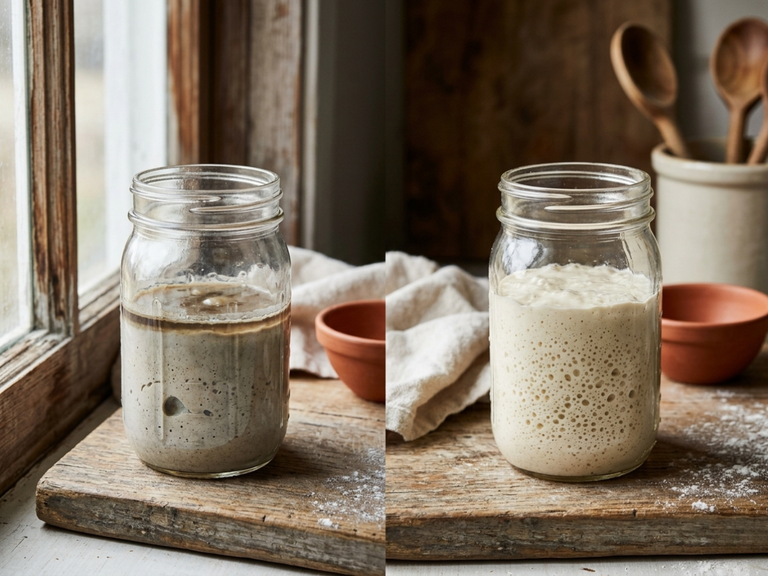
📷 The False Positive, Side by Side

A starter is a thick, sticky matrix of flour, water, wild yeast, and bacteria. As fermentation happens, that matrix traps carbon dioxide in thousands of tiny pockets – the same bubbles you can see on the surface and through the sides of the jar. Buoyancy is just physics: trapped gas plus a dense liquid equals something that floats, at least for a little while, regardless of how much leavening power is actually behind those bubbles.
That’s the false positive. A thin, recently-fed, or young starter can trap enough gas to float on pure surface activity, well before it has built the sustained fermentation strength to actually lift a loaf of dough over a 4-6 hour bulk rise. It floats today and lets you down at hour three of your bake.
The false negative works the other way. A very mature, very active, or higher-hydration starter can be so well-integrated – dough-like, almost – that gas escapes through the mass instead of staying trapped as buoyant pockets, or a hard stir right before the test knocks enough gas out that a perfectly capable starter sinks anyway. It sinks and would have baked you a beautiful loaf.
Buoyancy tells you about one spoonful, one moment, one texture. It doesn’t tell you about the thing you actually care about: whether your starter can do sustained work.
The Three Signs That Actually Work
1. Bubbles – all over, not just on top. Look at your starter through the side of the jar, not just down at the surface. A starter that’s genuinely active is riddled with bubbles top to bottom – small and large, throughout the mass, not just a foamy skin on top. A starter that’s only bubbly at the surface and dense or smooth underneath is usually not fully active yet.
📷 Sign One – Bubbles Throughout the Jar

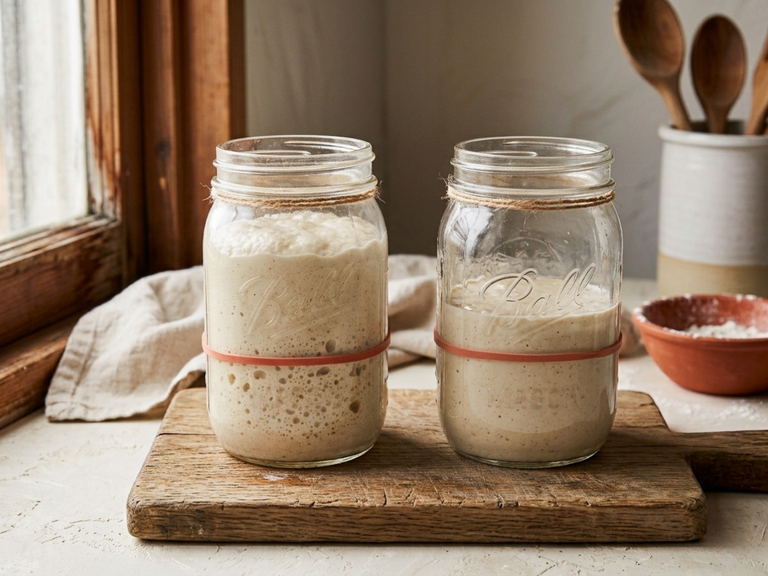
2. Consistent doubling – on a schedule, not just once. This is the one King Arthur leads with, and it’s the most trustworthy single sign on this whole list. Feed your starter, mark the jar with a rubber band or a strip of tape at the starting level, and watch it. A starter that’s genuinely ready reliably at least doubles within 6 to 8 hours of feeding – and does it consistently, feeding after feeding, not just as a one-time fluke. One good rise doesn’t prove readiness. A repeatable one does.
📷 Sign Two – Consistent Doubling With a Marker

3. Smell – sour, not sharp. A ready starter smells pleasantly sour: yogurt-like, a little tangy, sometimes faintly like ripe fruit. That’s lactic and acetic acid doing their job. A starter that smells sharply of acetone or nail polish remover is hungry, not ready. A starter that smells flat, like plain wet flour with no tang at all, usually hasn’t fermented enough yet. Your nose calibrates faster than you’d expect – after a few feedings, “ready” starts to have its own distinct smell you’ll just recognize.
Use the float test as a fourth, optional data point if you want – but let bubbles, doubling, and smell make the actual call.
Float Test vs. The Signs That Actually Work
| Test | What it actually measures | False positive risk | False negative risk | Verdict |
| Float test | Trapped gas making one spoonful buoyant, right now | High – thin, young, or gassy-but-weak starters float without real strength | Moderate – dense, well-integrated, or freshly-stirred starters can sink while fully capable | Use only as a tiebreaker, never alone |
| Bubbles throughout the jar | Active fermentation happening now | Low | Low | Reliable supporting sign |
| Consistent doubling (6-8 hrs) | Actual sustained leavening capacity | Very low | Very low | The most trustworthy sign – lead with this one |
| Smell (sour, not sharp or flat) | Fermentation byproducts in the expected balance | Low | Low | Good supporting sign; gets easier to read with practice |
↔ Swipe to see all columns
Gear That Makes This Easier
None of this requires special equipment, but three things make the doubling test a lot easier to read at a glance:
Gear That Makes This Easier
A clear, straight-sided jar or weck jar. Curved or tapered jars distort how “doubled” looks; straight sides make the rise easy to read honestly.
A rubber band or dry-erase marker to mark the starting level right after feeding, so “doubled” is a measurement, not a guess.
A kitchen scale, for keeping your feeding ratio consistent – an inconsistent ratio is one of the most common reasons a starter’s rise time seems to change for no reason.
FAQ
Is it bad if my starter never floats? Not necessarily. If it’s bubbly throughout, doubling reliably within 6-8 hours, and smells appropriately sour, it’s ready – regardless of what one spoonful does in a glass of water.
My starter floated, but my bread still came out dense. What happened? Almost certainly a false positive – surface gas made that one spoonful buoyant without the starter having the sustained strength to carry a full bulk fermentation. Check bubbles-throughout and doubling time next time instead.
Can an old or weak starter still pass the float test? Yes. A starter that’s underfed, too young, or otherwise weak can still trap enough gas in a single spoonful to float, even though it doesn’t have the strength to leaven a full loaf. This is exactly the false positive King Arthur’s testing identified.
How long should I wait between feeding and testing if I’m skipping the float test? Watch the clock from the moment you feed, and check bubbles and rise at the 4-, 6-, and 8-hour marks rather than testing once. A starter that’s reliably peaking somewhere in that window, every feeding, is the pattern you’re looking for – not a single point-in-time check.
What if my starter doubles but doesn’t smell sour yet? Give it a few more feedings. Rise speed and acid development don’t always arrive on exactly the same timeline, especially with a starter still under a few weeks old – smell tends to catch up as the culture matures.
Related Reading
- Starter 101, Step 1: Sourdough Starter From Scratch
- Starter 101, Step 2: How to Maintain (and Revive) Your Starter
- Why Does My Sourdough Starter Smell Like Nail Polish or Vinegar?
- Sourdough Starter Not Rising?
- The Sourdough Glossary – Float Test, Peak, Ripe
Still not sure what “ready” looks like in your own jar? The free 7-Lesson Starter Course walks you through exactly this, one short email at a time.
More Resources
Looking for a printable reference? Browse all six Printable Quicksheets, or dial in your own numbers with the Sourdough Calculator.
Knead to Know?
New recipes, baking tips, and sourdough troubleshooting — delivered before your starter even finishes its next rise.
Get the latest insights, no spam — just new recipes and baking tips. Unsubscribe anytime. See our Privacy Policy.