Sourdough Discard Pancakes
This is where all that discard I tell you not to throw away actually goes on a normal Tuesday. No overnight rest required – just stir, cook, and eat. The discard adds a faint tang and a wonderfully tender crumb that regular pancakes don’t have.
Why You’ll Love It
- Ready in under 30 minutes, start to finish – no fermentation wait required
- The easiest way to use up sourdough discard before it piles up in the fridge
- A subtle tang and extra-tender crumb that plain pancakes don’t have
- One bowl, one whisk, no mixer needed
- Freezes well for fast weekday breakfasts
Ingredients
Volume measurements are included for convenience, but they’re approximate – a kitchen scale will always get you a more consistent batch, especially for the flour.
Unfed sourdough discard works perfectly here – this is exactly the kind of recipe it’s made for.
- Sourdough discard (240 g / 1 cup), unfed and straight from the fridge is fine: the tang and hydration are what give these pancakes their texture.
- All-purpose flour (125 g / 1 cup): keeps the crumb light; no need for bread flour here.
- Whole milk (180 g / ¾ cup): thins the batter to pourable pancake consistency.
- Egg (1 large): adds structure and richness.
- Granulated sugar (25 g / 2 Tbsp): a light sweetness in the batter itself, beyond whatever you add on top.
- Unsalted butter (28 g / 2 Tbsp), melted and slightly cooled: adds tenderness and flavor.
- Baking soda (1 tsp): part of the fast-acting lift a discard recipe needs, since there’s no time for the starter itself to leaven anything.
- Baking powder (1 tsp): the other half of that lift, working alongside the baking soda.
- Fine sea salt (¼ tsp): balances the sweetness.
Equipment
- Griddle or large nonstick skillet: for even, consistent cooking.
- Ladle or ¼-cup measuring cup: for evenly sized pancakes.
Sample Schedule (1-Day)
Same Day
- Mix the batter (about 10 minutes)
- Rest the batter 10 minutes while the griddle heats
- Cook, about 3 minutes per batch
- Serve warm

Sourdough Discard Pancakes
Method
- Whisk discard, milk, egg, sugar, and melted butter together until smooth.
- Sprinkle flour, baking soda, baking powder, and salt over the top and whisk just until combined.
- Rest the batter 10 minutes while the griddle preheats over medium heat.
- Grease the griddle and pour ¼ cup of batter per pancake.
- Cook 2–3 minutes until bubbles form, then flip and cook 1–2 minutes more.
- Serve warm with butter and syrup.
Notes
Save This Recipe
Get it emailed to you now, plus new recipes as they go up.
Your email is safe with me. I’ll send this recipe straight over. No spam, ever—and you can unsubscribe anytime.
How to Make It
1Whisk the wet ingredients. In a large bowl, whisk together 240 g (1 cup) sourdough discard, 180 g (¾ cup) milk, 1 egg, 25 g (2 Tbsp) sugar, and 28 g (2 Tbsp) melted butter until smooth.
2Add the dry ingredients. Sprinkle 125 g (1 cup) flour, 1 tsp baking soda, 1 tsp baking powder, and ¼ tsp salt over the wet mixture. Whisk just until combined – a few small lumps are fine and better than overmixing.
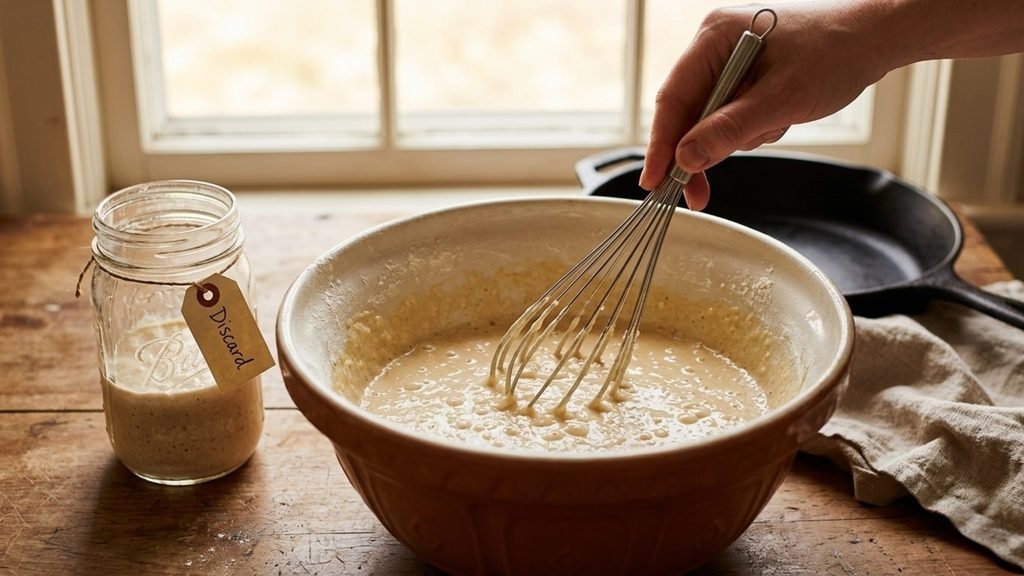
3Rest. Let the batter sit for 10 minutes while your griddle or skillet preheats over medium heat. This short rest lets the baking soda and baking powder start working and the flour fully hydrate.
4Grease the griddle. Lightly grease the hot griddle with butter or oil. Test with a small drop of batter – it should sizzle gently, not smoke.
5Cook the first side. Pour or ladle about ¼ cup of batter per pancake onto the griddle. Cook for 2 to 3 minutes, until bubbles form across the surface and the edges look set.
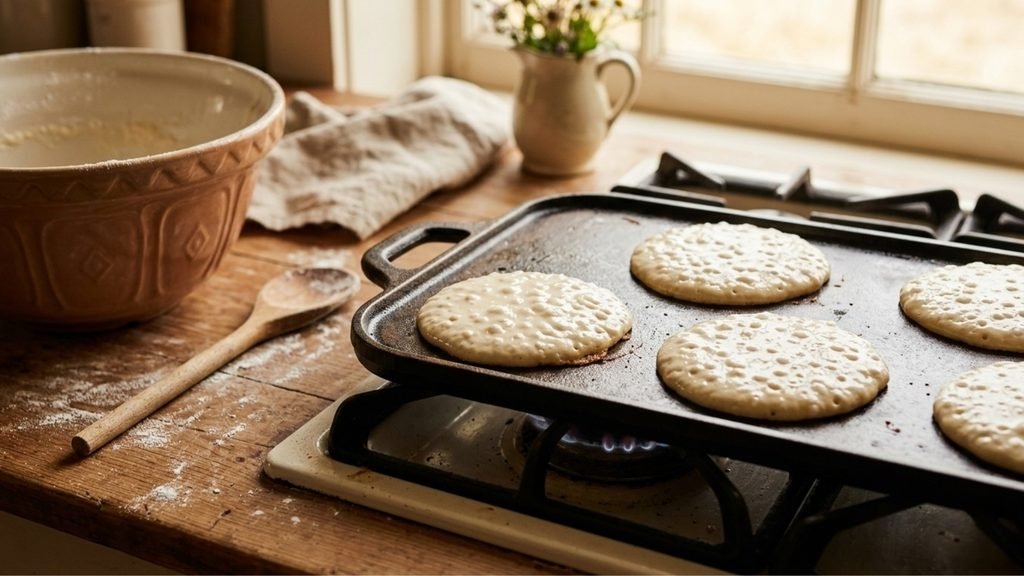
6Flip and finish. Flip and cook 1 to 2 minutes more, until golden on the second side and cooked through. Repeat with the remaining batter, regreasing the griddle as needed.
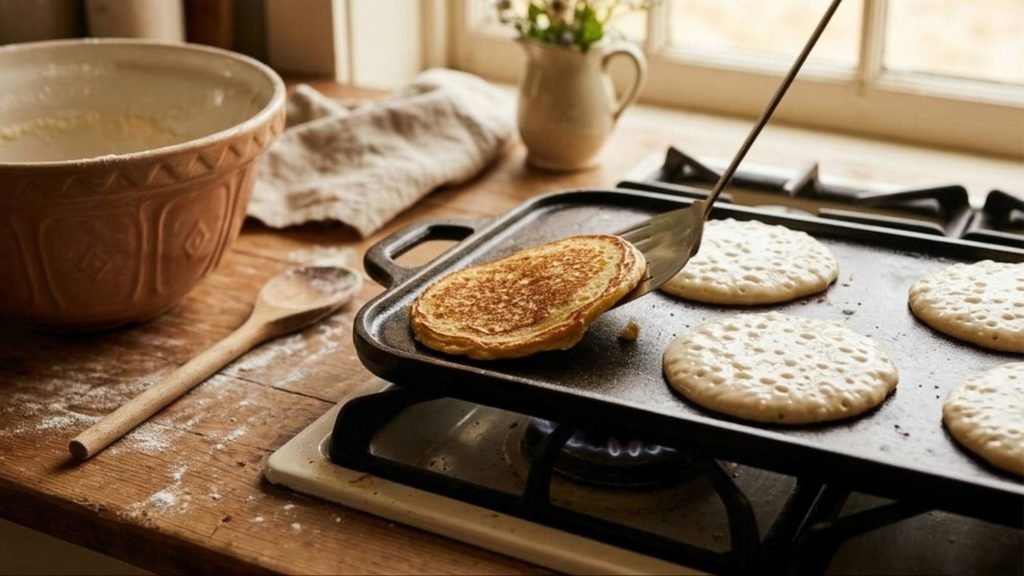
7Serve warm. Serve immediately with butter and maple syrup, or keep finished pancakes warm in a 200°F oven while you finish the batch.
Tips & Troubleshooting
- Don’t overmix: a few flour streaks or small lumps in the batter are exactly right – overmixing develops gluten and makes the pancakes tough instead of fluffy.
- Discard straight from the fridge is fine: it doesn’t need to come to room temperature first, and cold discard won’t hurt the texture.
- Test your griddle heat: a properly heated griddle should make a drop of batter sizzle right away without smoking. Too hot browns the outside before the inside cooks.
- Batter thickness: if your discard is on the thicker side, thin the batter with a splash more milk; if it’s thin, add a touch more flour.
How to Store
To store: keep cooked pancakes in an airtight container in the fridge for up to 3 days.
To freeze: cool completely, then freeze in a single layer before transferring to a bag. Reheat straight from frozen in a toaster or 350°F oven.
Nutrition
Per pancake, based on 10 pancakes. Estimated from the ingredients used – provided for convenience and not a substitute for a precise calculation.
120
CALORIES
18
CARBS (G)
4
PROTEIN (G)
4
FAT (G)
2
SAT. FAT (G)
4
SUGAR (G)
210
SODIUM (MG)
Desi’s Notes
This is the recipe that finally stopped me from feeling guilty about discard. If you keep your starter on the counter and feed it daily, this is a genuinely good use for what would otherwise go down the drain.
Unlike my loaves, there’s no fermentation window to watch here – this batter doesn’t get better with time, so mix it, rest it the 10 minutes, and cook. Letting it sit much longer can actually make the pancakes gummy.
Before You Bake
Scaling this recipe up or down? Run your numbers through the Sourdough Calculator. And if you want a printable reference for troubleshooting or timing, browse all six Printable Quicksheets.
Knead to Know?
New recipes, baking tips, and sourdough troubleshooting — delivered before your starter even finishes its next rise.
Get the latest insights, no spam — just new recipes and baking tips. Unsubscribe anytime. See our Privacy Policy.



Tried this recipe? Leave a star rating below — it takes 10 seconds and helps other bakers decide what to make next.
Baked this recipe your way? Share it in Community Bakes and inspire other readers.